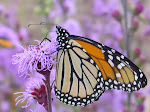

Today I was driving over to a client's home this morning and I was listening to Minnesota Public Radio. Cathy Wurzer was interviewing entomologist Marla Spivack of the University of Minnesota about the continual decline of honeybees in the United States.
Spivack's voice wavered on air when she described how "bees are calling out for help", these bees need our help. I got a lump in my throat as I heard this. She said that our urban and agricultural environments are not hospitable to honey bees. Many flowers that bees pollinate are contaminated with residual herbicides, pesticides and fungicides.
When I heard urban environments are not hospitable. I began remembering how the herbicidal industry as a whole is a multi billion dollar industry and that agriculture cannot bear the brunt of blame for all that chemical use. Home owners in urban/suburban America use at least 50% of all herbicides.
Many flowers that are used in urban/suburban gardens or landscapes are not native. Many plants are cultivars that offer "perfect" looks but little ecological benefits (nectar) to insect pollinators or bees for that matter.
Gardeners in our society are taught to value "perfect" looking plants, and the minute insects take a nibble out of plants or a plant gets mildew; gardeners dowse plants with insecticides and fungicides. Native honey bees and introduced honey bees are paying the price with thier health and lives.
According to Spivack, when herbicides, pesticides and fungicides get into honey bees' bodies, they are weakened and become more susceptible to diseases and parasites. This apparently is the cause of colony collapse.
How can we help honey bees in the urban environment?
A.) We can reduce or eliminate harmful chemical uses.
B.) We can plant more flowers. And we can use various flowers (and wildflowers) that can offer nectar through the spring-summer-fall seasons.
C.) Spivack added that flowers from the mint family are especially valuable to honey bees. She mentioned Sage and Hyssop are very good. She also mentioned plants from the Composite Family or Asteraceae Family with is a massive group of plants which include a host of excellent native wildflowers.
D.) We can help restore natural corridors of prairie/savanna into or urban lands.
E.) Collectively, urban gardeners can install gardens using nectar rich native wildflowers and make positive impacts for the wellness of bees.
F.) Did you know that Minnesota is one of the largest honey producers in the United States?
26 March 2010

22 March 2010
Spring Equinox Greetings
Hello Everybody,
Spring weather has arrived to the Twin Cities several weeks ago with warmer than average temperatures and lots of sun! Officially, we welcomed Spring on March 20th this year.
It is my hope for myself and for all you; to continue our deepening relationship with the environment around us....and especially at our homes. It is at each of our homes that we can provide refuge for soil organisms, native plants, native insects and birds. I encourage us all to stimulate our imaginations by observing and creating spaces and places that we can co-exist with these various species here on Earth, our great home.
This spring we were greeted with "snow mold". Snow mold developed really well under the deep snows that were with us all winter. The mold was revealed after warm temperatures and rain melted all that snow within a couple of weeks. Then the sun came out and dried it out. The snow mold was even mentioned on a local news website.
Buds on Amelanchier alnifolia (Saskatoon Serviceberry), Aronia melanocarpa (Glossy Black Chokeberry), Prunus virginiana (Common Chokecherry), Prunus pennsylvanica (Pin Cherry) are beginning to swell a little. These plants produce fruit during the summer that is eaten by birds such as Robins, Cardinals and Catbirds in the city.
I know people who have been collecting sap from Acer saccharum (Sugar Maple) and Acer saccharinum (Silver Maple) for the past 3 weeks. This sap will be cooked and eventually become delicious "maple syrup". American indians such as the Dakota and Anishinaabe made maple syrup for centuries before European settlers learned how to make it too.
My father is planning to remove a dense patch of Aster oolentangiensis (Sky Blue Aster) that is native. He is going to replace these plants with a dense grouping of Liatris ligulistylis (Meadow Blazingstar) which is also native. He wants to attract Monarchs to his backyard and he know this plant is excellent for attracting Monarch butterflies.
My friend Duane is going to breed Hepatica acutiloba (Sharp Lobed Hepatica). This plant is a native woodland wildflower that has beautiful little white or pale blue flowers. The foliage grows in little mounds. According to Duane these plants are very popular in England and are somewhat deer resistant here in Minnesota.
Spring weather has arrived to the Twin Cities several weeks ago with warmer than average temperatures and lots of sun! Officially, we welcomed Spring on March 20th this year.
It is my hope for myself and for all you; to continue our deepening relationship with the environment around us....and especially at our homes. It is at each of our homes that we can provide refuge for soil organisms, native plants, native insects and birds. I encourage us all to stimulate our imaginations by observing and creating spaces and places that we can co-exist with these various species here on Earth, our great home.
This spring we were greeted with "snow mold". Snow mold developed really well under the deep snows that were with us all winter. The mold was revealed after warm temperatures and rain melted all that snow within a couple of weeks. Then the sun came out and dried it out. The snow mold was even mentioned on a local news website.
Buds on Amelanchier alnifolia (Saskatoon Serviceberry), Aronia melanocarpa (Glossy Black Chokeberry), Prunus virginiana (Common Chokecherry), Prunus pennsylvanica (Pin Cherry) are beginning to swell a little. These plants produce fruit during the summer that is eaten by birds such as Robins, Cardinals and Catbirds in the city.
I know people who have been collecting sap from Acer saccharum (Sugar Maple) and Acer saccharinum (Silver Maple) for the past 3 weeks. This sap will be cooked and eventually become delicious "maple syrup". American indians such as the Dakota and Anishinaabe made maple syrup for centuries before European settlers learned how to make it too.
My father is planning to remove a dense patch of Aster oolentangiensis (Sky Blue Aster) that is native. He is going to replace these plants with a dense grouping of Liatris ligulistylis (Meadow Blazingstar) which is also native. He wants to attract Monarchs to his backyard and he know this plant is excellent for attracting Monarch butterflies.
My friend Duane is going to breed Hepatica acutiloba (Sharp Lobed Hepatica). This plant is a native woodland wildflower that has beautiful little white or pale blue flowers. The foliage grows in little mounds. According to Duane these plants are very popular in England and are somewhat deer resistant here in Minnesota.
18 February 2009
Seminars: for Urban Landscaping
March 4th, 2009 Wednesday 7:00pm
Parkway Garden Club
Landscaping for Birds
Speaker: Erik James Olsen, Landscape Designer, MLA
Out Back Nursery & Landscaping
Heritage Place of Roseville
563 county Road BW
Roseville, MN 55113
Free. For more information call 651-353-4284.
March 5th, 2009 Thursday 7:00pm-8:30pm
Buckthorn in Your Yard and What To Do With It
Speaker: Erik James Olsen, Landscape Designer, MLA
Out Back Nursery & Landscaping
Lyngblomsten Center Community Room
Saint Paul, MN(accessible from either Pascal St.or the main entrance off 1415 Almond Avenue. Follow the signs inside to the Community Room)
Contact: Mike MacDonald mrmacpc@yahoo.com 952-201-2845
March 16th, 2009 7:00pm
Speaker: Douglas Tallamy
Author of Bringing Nature Home: How to Sustain Wildlife in Our Gardens
John B. Davis Lecture Hall
Ruth Stricker Dayton Campus Center
Macalester College, Saint Paul MN
(corner of Grand Ave. & Snelling Avenue)
Free & Open to the public
Parkway Garden Club
Landscaping for Birds
Speaker: Erik James Olsen, Landscape Designer, MLA
Out Back Nursery & Landscaping
Heritage Place of Roseville
563 county Road BW
Roseville, MN 55113
Free. For more information call 651-353-4284.
March 5th, 2009 Thursday 7:00pm-8:30pm
Buckthorn in Your Yard and What To Do With It
Speaker: Erik James Olsen, Landscape Designer, MLA
Out Back Nursery & Landscaping
Lyngblomsten Center Community Room
Saint Paul, MN(accessible from either Pascal St.or the main entrance off 1415 Almond Avenue. Follow the signs inside to the Community Room)
Contact: Mike MacDonald mrmacpc@yahoo.com 952-201-2845
March 16th, 2009 7:00pm
Speaker: Douglas Tallamy
Author of Bringing Nature Home: How to Sustain Wildlife in Our Gardens
John B. Davis Lecture Hall
Ruth Stricker Dayton Campus Center
Macalester College, Saint Paul MN
(corner of Grand Ave. & Snelling Avenue)
Free & Open to the public
28 January 2009
February 13–16, 2009.
The Great Backyard Bird Count
The Great Backyard Bird Count is led by the Cornell Lab of Ornithology and National Audubon Society,
with sponsorship from Wild Birds Unlimited.
The Great Backyard Bird Count is an annual four-day event that engages bird watchers of all ages in counting birds to create a real-time snapshot of where the birds are across the continent. Anyone can participate, from beginning bird watchers to experts. It takes as little as 15 minutes on one day, or you can count for as long as you like each day of the event.
It’s free, fun, and easy—and it helps the birds. They will be adding updated 2009 GBBC materials as they become available.
Use this link to find more information at:
http://www.birdsource.org/gbbc/
The Great Backyard Bird Count
The Great Backyard Bird Count is led by the Cornell Lab of Ornithology and National Audubon Society,
with sponsorship from Wild Birds Unlimited.
The Great Backyard Bird Count is an annual four-day event that engages bird watchers of all ages in counting birds to create a real-time snapshot of where the birds are across the continent. Anyone can participate, from beginning bird watchers to experts. It takes as little as 15 minutes on one day, or you can count for as long as you like each day of the event.
It’s free, fun, and easy—and it helps the birds. They will be adding updated 2009 GBBC materials as they become available.
Use this link to find more information at:
http://www.birdsource.org/gbbc/
21 January 2009
Movies: Gardening Passively During Winter
This is a list of movies that I have enjoyed over the years that reference gardening is some way or another. I thought it would be fun to share these movies with you.
Balian (Orlando Bloom) Kingdom of Heaven Director's Cut
He develops irrigation for crops in the desert. It is a beautiful part of the movie where he collaborates with the local peoples.
Maximus (Russell Crowe) in Gladiator
references are made to his farming at his estate; raises grains
Samwise Gamgee (Sean Astin) Lord of the Rings: Fellowship of the Ring
Sam is shown gardening in the shire; movie is full of inspiring landscapes and otherworldly beings.
Roger the Shrubber (Michael Palin) The Holy Grail
"I arrange, design, and sell shrubberies".
Tinle (Thilen Lhondup) Himalaya
He and his community raise grains for trade
Jack Meadows (Timothy Hutton) Sunshine State
a landscape architect/does residential golf course developments. There is even a reference to Frederick Law Olstead "the father of
landscape architecture".
Wong Kei-ying (Lung Ti) The Legend of the Drunken Master
raises herbs and Bonsai; he and his two sons deliver a very special ginseng root for a client.
Professor Pomona Sprout (Miriam Margolyes) Harry Potter
raises various plants with healing properties
Justin Quayle (Ralph Fiennes) The Constant Gardener
Bronte Parrish (Andi McDowell) Green Card
a horticulturalist who finds the perfect apartment with a greenhouse but it is for married couples only.
Chance (Peter Sellers) Being There
A simple-minded gardener with no knowledge of the world except what he has learned from television. He becomes an unlikely political insider.
Mr. Bennet (Donald Sutherland) Pride & Prejudice
He grows orchids; his daughter Elizabeth enjoys walking through beautiful, picturesque landscapes.
Elinor Dashwood (Emma Thompson) Sense & Sensibility
She is shown gardening towards the end of the movie.
My Neighbor Totoro directed by Hayao Miyazaki
Totoro, his friends and two children nurture tree seeds to grow into a massive tree.
This is an animation masterpiece.
Balian (Orlando Bloom) Kingdom of Heaven Director's Cut
He develops irrigation for crops in the desert. It is a beautiful part of the movie where he collaborates with the local peoples.
Maximus (Russell Crowe) in Gladiator
references are made to his farming at his estate; raises grains
Samwise Gamgee (Sean Astin) Lord of the Rings: Fellowship of the Ring
Sam is shown gardening in the shire; movie is full of inspiring landscapes and otherworldly beings.
Roger the Shrubber (Michael Palin) The Holy Grail
"I arrange, design, and sell shrubberies".
Tinle (Thilen Lhondup) Himalaya
He and his community raise grains for trade
Jack Meadows (Timothy Hutton) Sunshine State
a landscape architect/does residential golf course developments. There is even a reference to Frederick Law Olstead "the father of
landscape architecture".
Wong Kei-ying (Lung Ti) The Legend of the Drunken Master
raises herbs and Bonsai; he and his two sons deliver a very special ginseng root for a client.
Professor Pomona Sprout (Miriam Margolyes) Harry Potter
raises various plants with healing properties
Justin Quayle (Ralph Fiennes) The Constant Gardener
Bronte Parrish (Andi McDowell) Green Card
a horticulturalist who finds the perfect apartment with a greenhouse but it is for married couples only.
Chance (Peter Sellers) Being There
A simple-minded gardener with no knowledge of the world except what he has learned from television. He becomes an unlikely political insider.
Mr. Bennet (Donald Sutherland) Pride & Prejudice
He grows orchids; his daughter Elizabeth enjoys walking through beautiful, picturesque landscapes.
Elinor Dashwood (Emma Thompson) Sense & Sensibility
She is shown gardening towards the end of the movie.
My Neighbor Totoro directed by Hayao Miyazaki
Totoro, his friends and two children nurture tree seeds to grow into a massive tree.
This is an animation masterpiece.
19 January 2009
American Robins: Overwintering in MN
American Robins are known to overwinter in Minnesota in modest numbers. I have occasionally seen a Robin or two over the years. However, this year I have seen quite a few. Last week, during the sub-zero temperatures, I saw three separate flocks (on the same day!) feeding on the berries of Hackberry trees (Celtis occidentalis). Each flock numbered about 24 to 36 birds.
My dad reported several American Robins eating the small, red fruits on his Eastern Wahoo tree (Euonymus atropurpurea) last week. He adds, "This is the third winter that the female Cardinal has eaten berries from this tree." This is exciting to know because I have not heard many reports regarding what birds feed on the fruit of Eastern Wahoo.
I am glad these birds are finding food at this time of year. If American Robins are shifting their winter ranges farther north, it is not clear. I have heard reports that birds are more sensitive to climate change. Birds are more sensitive to climate change whether the shifting is due to short term weather patterns or long terms changes. Northern Cardinals shifted north years ago and we enjoy seeing them during our winter seasons.
All sightings were in Saint Paul, MN
My dad reported several American Robins eating the small, red fruits on his Eastern Wahoo tree (Euonymus atropurpurea) last week. He adds, "This is the third winter that the female Cardinal has eaten berries from this tree." This is exciting to know because I have not heard many reports regarding what birds feed on the fruit of Eastern Wahoo.
I am glad these birds are finding food at this time of year. If American Robins are shifting their winter ranges farther north, it is not clear. I have heard reports that birds are more sensitive to climate change. Birds are more sensitive to climate change whether the shifting is due to short term weather patterns or long terms changes. Northern Cardinals shifted north years ago and we enjoy seeing them during our winter seasons.
All sightings were in Saint Paul, MN
07 January 2009
Northern Shrike Sighting
 This Sunday, my family was visiting my parents house in Saint Paul, MN. We were enjoying some hot tea and cookies when my dad excitedly announced, "Everyone, come to the window and look at who is sitting on the bird feeder!" We all stopped visiting and looked out the window together. My dad asked if we knew what it was? We guessed wrong several times but finally named the bird....A Northern Shrike.
Photo by: Tom Munson
This is exciting for us becuase their back yard is located in the city. This is a bird that is more commonly seen in rural areas. This was my second sighting of a Shrike in my life. Happy New Year to you and yours!!!!
Subscribe to:
Posts (Atom)